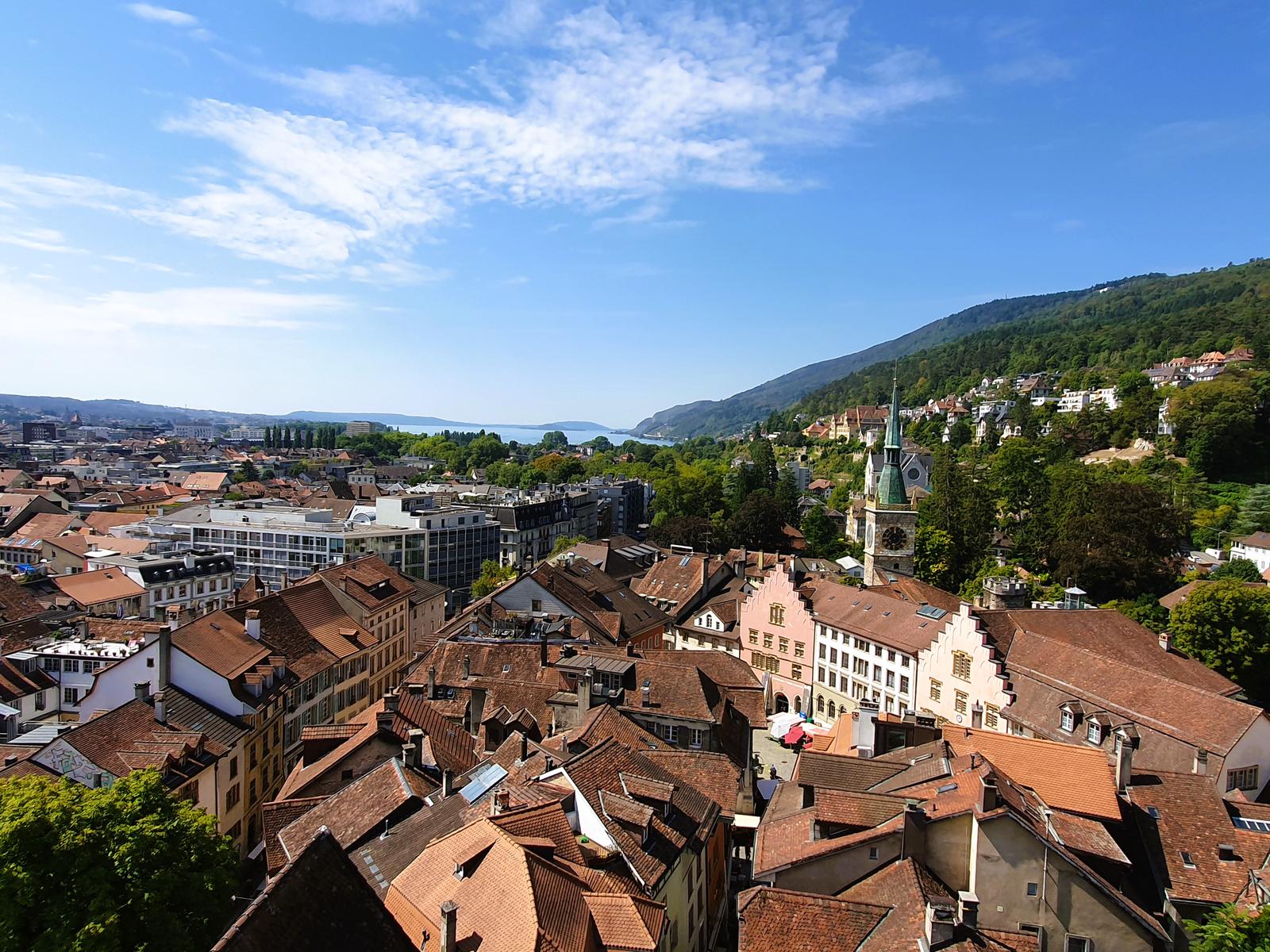
Biel sits at the north-eastern end of Lake Biel, at the southern foot of the Jura, about 26 kilometres north-west of Bern. With 56,896 residents (as of 31 December 2024) it is Switzerland's tenth-largest city and the largest bilingual one. German and French stand side by side as equals: in the city council, in schools and often within a single conversation. Biel is known above all for watches. The Swatch Group is headquartered here, Rolex produces in the city, and the Federation of the Swiss Watch Industry FH is also based here.
History
In 1142 the name Biel appears for the first time in a document, then written as apud Belnam. The town was founded between 1220 and 1230 by the Prince-Bishop of Basel, whose territory reached down to Lake Biel. In 1275 King Rudolf of Habsburg granted the town charter. For centuries Biel lived on viticulture, crafts and trade. The medieval old town on the rocky spur above the Schüss is well preserved. The Ring with its arcades, the narrow lanes and the old fountains shape the picture. The turning point came with the watchmaking industry from the mid-19th century. In 1873 the watchmaking school opened, later growing into today's Bern University of Applied Sciences. The population grew quickly, and with it the new town around the station.
In 1142 the name Biel appears for the first time in a document, then written as apud Belnam. The town was founded between 1220 and 1230 by the Prince-Bishop of Basel, whose territory reached down to Lake Biel. In 1275 King Rudolf of Habsburg granted the town charter. For centuries Biel lived on viticulture, crafts and trade. The medieval old town on the rocky spur above the Schüss is well preserved. The Ring with its arcades, the narrow lanes and the old fountains shape the picture. The turning point came with the watchmaking industry from the mid-19th century. In 1873 the watchmaking school opened, later growing into today's Bern University of Applied Sciences. The population grew quickly, and with it the new town around the station.
Watches, university and research
Biel calls itself the watch capital of the world, and there is substance behind the label. Alongside the Swatch Group and its brands such as Omega, Rolex produces in the city, joined by many suppliers in precision and microtechnology. In 2021 the Switzerland Innovation Park Biel/Bienne (SIPBB) opened near the station, right next to the new campus of Bern University of Applied Sciences. Research, university and industry therefore sit within a few hundred metres of each other. Biel is a university town: Bern University of Applied Sciences teaches engineering, computer science, architecture and wood here, and Bern Academy of the Arts is also present with several departments.
Living by the lake and the Jura
Anyone living in Biel has the lake on their doorstep. From the centre the lakeside promenade is about a fifteen-minute walk. In summer scheduled boats cross Lake Biel to St. Peter's Island and the wine villages on the left shore. Behind the city the Jura begins: the Taubenloch gorge runs from Bözingen through a narrow cleft of the Schüss and is easy to reach by bus. Wine from Lake Biel, hikes along the foot of the Jura and the Three-Lakes Region with the lakes of Neuchâtel and Murten are all within reach. There is plenty going on culturally: the Centre PasquArt shows contemporary art, the Neues Museum Biel (NMB) combines art and history, and the Biel Solothurn Theatre and Orchestra performs in both languages.
Bilingualism in everyday life
In Biel, bilingualism is both daily life and law. German and French are both official languages of the municipality. About 57 percent of residents mainly use German in everyday life, about 43 percent French. Authorities, schools and signage are bilingual throughout, and the Conseil des affaires francophones represents the French-speaking population. For visitors, in practice: German or French will get you everywhere, and many people switch between the two without effort.
Getting there and around
Biel is a rail junction at the foot of the Jura. Direct trains run to Bern (about 25 minutes), Neuchâtel, Solothurn, Zurich and Basel. The station sits at the edge of the new town; from there Zentralplatz and the old town are a few minutes on foot. Within the city, buses and trolleybuses of the Biel transport company run regularly. Zentralplatz is the central point: this is where the canalised arm of the Schüss divides the new town, where the bus lines cross, and where the pedestrian zone towards the old town begins.
Frequently asked questions
Do people speak German or French in Biel?
Both. Biel is Switzerland's largest bilingual city; German and French are both official languages. About 57 percent of residents mainly speak German in everyday life, about 43 percent French. Either language will get you everywhere. More on Wikipedia.
How do I get to Biel?
Biel is a rail junction. Direct trains run to Bern (about 25 minutes), Neuchâtel, Solothurn, Zurich and Basel. From the station, Zentralplatz and the old town are a few minutes on foot.
What can I see in Biel in one day?
From the station to Zentralplatz, on into the medieval old town with the Ring and the arcades, then about a fifteen-minute walk to Lake Biel. That way you see the new town, the old town and the lake in one day.
What can you do at Lake Biel?
In summer scheduled boats go to St. Peter's Island and the wine villages on the left shore. At the edge of town the Strandboden and the lido are good for swimming, and the Taubenloch gorge near Bözingen is a short trip into the Jura.
What is Biel known for?
For watches. The city of Biel is the headquarters of the Swatch Group, Rolex produces here, and the city is described as the watch capital of the world. Biel is also a university town, with Bern University of Applied Sciences and the Switzerland Innovation Park.
Is the city called Biel or Bienne?
Both are correct. Biel is the German name, Bienne the French one. Officially the city is called Biel/Bienne. In everyday use people say Biel or Bienne depending on the language.