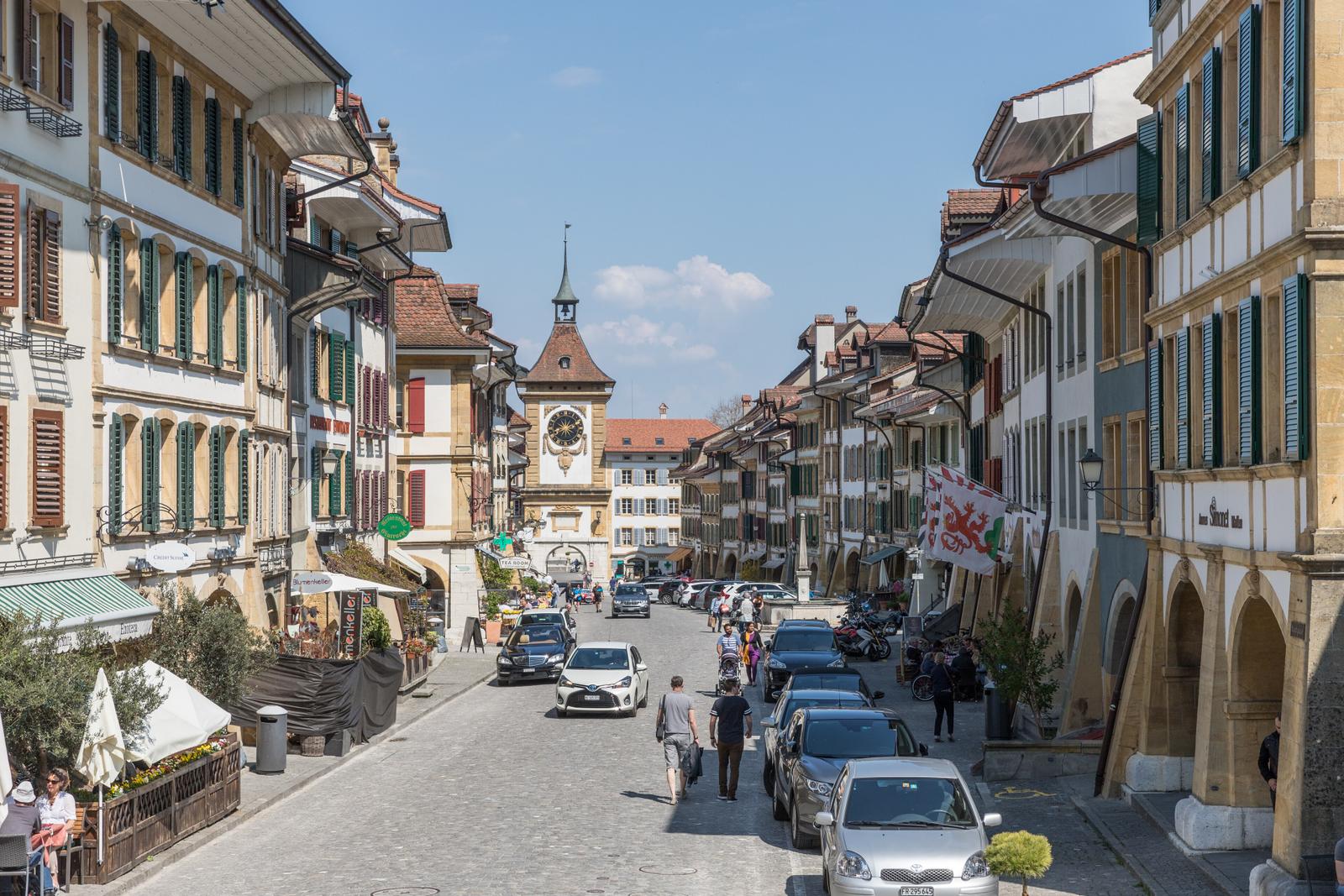
Murten sits on the southeastern shore of Lake Murten, on a rise 453 metres above sea level, in the canton of Fribourg. Around 9,500 people live in the municipality, which after the 2016 and 2022 mergers also includes Galmiz, Gempenach and the formerly Bernese municipality of Clavaleyres. Anyone entering the old town passes through a town wall that has survived almost intact since 1238: twelve towers, arcaded walkways, a 13th-century castle. The picture from the travel brochures is accurate here, but it is only part of the town. Murten has a lake beach with a 50-metre pool, a museum in an old mill, an open-air classical music festival in August, and a popular road race that has sent thousands of runners to Fribourg every autumn since 1933.
The old town behind the wall
Between 1157 and 1177, Duke Berchtold IV of Zähringen founded the town of Murten, using the same rectangular layout his family also used in Bern and Fribourg. The town wall was built from 1238 and extended in several stages. With an average height of 8.5 metres it survives almost intact, with twelve towers and a 15th-century parapet walk that can still be walked along the southern stretch. The Bernese Gate to the northeast took its current form in 1778 and is one of the town's two former main entrances.
On 22 June 1476, Charles the Bold, Duke of Burgundy, laid siege to the town. The Swiss Confederates and their allies defeated his army at the Battle of Murten, a turning point in the Burgundian Wars. Two events on the calendar still commemorate it: the Solennität on 22 June, a school and youth festival with 22 cannon salutes and a procession through the streets, and the historic Murten shooting event on the Bodemünzi hill, held around the same date. The castle at the southwestern edge of the old town, built from the mid-13th century under Peter II of Savoy, today houses the prefecture of the See district and is not regularly open as a museum. Anyone wanting the detailed town history instead heads to the old town mill of 1578, below the castle.
Museum and concerts: what's on in Murten
The Museum Murten occupies this old town mill, outside the wall, below the castle. The permanent exhibition, "A House Tells Stories," covers 6,000 years of the town's and region's history, from Neolithic lakeshore settlements to the Battle of Murten, staged as a multimedia display. It is open from February to December, Tuesday to Saturday 2 to 5pm and Sunday 10am to 5pm, closed Mondays except public holidays. Admission is CHF 8 for adults, CHF 5 reduced, CHF 2 for children and teenagers aged 6 to 16. In 2026 the museum also shows the special exhibition "Grandson – Murten 2026" on the commemorations of the two 1476 battles, from early May to early October.
Since 1989, the Murten Classics summer festival has run in August, an open-air classical music festival with more than 30 concerts and around 800 musicians from across Europe. The main venue is the castle courtyard, overlooking the sunset over the lake; further concerts take place in the French Church and in the castle park at Münchenwiler. In 2026 the festival runs from 9 to 30 August under the motto "Freedom," as part of the commemorations of the 1476 battle. Artistic director Christoph-Mathias Mueller picks a theme each year to guide the programme, from orchestral concerts to the family concert on the closing Sunday.
Murten's old-town carnival, the Fastnacht, has run in its current form since 1950 and lasts three days and nights, from the first Saturday afternoon in March to the night from Monday to Tuesday. In Murten the word is spelled with a t in the middle, "Fastnacht," not "Fasnacht." The Sunday afternoon procession sends themed floats and Guggenmusik brass bands through the old town's narrow lanes; in good weather up to 12,000 spectators line the route. Saturday afternoon belongs to the children, and on Monday evening the "Füdlibürger" effigy is burned.
On the water: swimming, rowing, boats
The Murten indoor, outdoor and lake pool complex sits on Lausannestrasse, a seven-minute walk from the station. On the lake side there is a 50-metre pool, a 60-metre slide, a sandy beach with jetties and a beach volleyball court. The 2026 bathing season runs from 9 May to 20 September, daily 9am to 9pm in the main season from late May to late August, and 9.30am to 7pm in the shoulder seasons. Adults pay CHF 8, students, apprentices and old-age pensioners CHF 7, children aged 6 to 15 CHF 5. The indoor pool, with a 25-metre lane pool, a non-swimmers' pool and a sauna, closes for cleaning during the summer months but otherwise runs year-round.
From the harbour, the LNM shipping company runs a round trip around Lake Murten, stopping at Môtier and Faoug, in about 75 minutes. To continue further, the route runs through the Broye canal to Neuchâtel, or on through the Zihl canal to Biel; the full three-lake trip takes about four hours. The Swiss travelcard (GA) is valid on all LNM boats, including on Lake Murten. The season runs from April to October, weekends only at the start and end, daily during the main season.
Sport and clubs
The Murten-Fribourg race is the oldest popular road race still held in Switzerland, first run in 1933. The 17.17-kilometre course runs from the Hauptgasse in Murten (453 m above sea level) to Place Georges-Python in Fribourg (615 m above sea level), with a total climb of 388 metres. The race recalls the legend of a messenger who, after the 1476 battle, is said to have run from Murten to Fribourg with a linden branch in hand to announce the victory. In 2026 the race takes place on 4 October, as it does every first Sunday of October. Joggers and walkers can take a shorter course starting in Courtepin, and children from age four can join the Mini race on Saturday afternoon in Fribourg's city centre.
For everyday sport, Murten has football and tennis pitches, a tennis and squash hall, and the year-round indoor pool. The town library and a toy-lending library round out the offering for families.
Food, markets and what's left of the weekly market
The weekly market on Berntorplatz has practically ceased to exist after 15 years. The number of stallholders declined from 2017 onward, worsened by the pandemic from 2020: from 12 to 15 stalls at its peak, only the Rentsch family's stall remained by 2023, after the cheese-maker and the bakery also stopped taking part. The town of Murten and the Shopping Murten association tried to revive the market with ideas and support, without much success. The Rentsch family still sells on the square on Saturdays and additionally delivers vegetable boxes on Fridays.
The larger markets that remain on the calendar are a different story. The Maimarkt brings retailers and craftspeople into the old town's alleys each spring, from 10am to 5pm. Every first Wednesday of November, the "Stedtli" turns into the Martinsmarkt, and the alleys smell of onion tart, hot chestnuts and raclette. The last Saturday of October brings the truffle market, with more than 20 stalls devoted to Swiss truffles, complemented by a wine tasting with vintner Christophe Dupasquier from Vully at the Hotel Murtenhof & Krone. In December, the Murten Christmas market opens, Friday 4 to 10pm, Saturday 10am to 10pm and Sunday 10am to 5pm.
Two addresses come up repeatedly in dining recommendations: the Hotel Murtenhof & Krone in the old town, whose late-Gothic fabric dates back to 1476, and La Pinte du Vieux Manoir, with a lake view and sun terrace, outside the town wall. Both sit on or close to the lake promenade.
Families and kids
The lake pool has a paddling pool for babies and toddlers, a non-swimmers' pool at 30 degrees and playgrounds; on Tuesdays and Saturdays the paddling pool water is additionally warmed to 33 degrees. The Mini race on Saturday afternoon, before the main race, is aimed at children from age four, who run between one and five laps in Fribourg's city centre depending on their age category. Murten Classics puts on a family concert in the French Church on the festival's closing Sunday each year.
What changes with the seasons
In March, Fastnacht takes over the old town for an extended weekend. In June, the Solennität and the historic Murten shooting event commemorate the 1476 battle. In August, Murten Classics fills the castle courtyard with classical music late into the evening. In October, two major events land in the same month: the Murten-Fribourg race on the first Sunday and the truffle market on the last Saturday. In November, the smell of onion tart drifts through the Martinsmarkt's alleys, and in December the Christmas market takes over. In between, from May to September, the lake sets the real pace: the lake pool, boats and the lakeside promenade shape daily life more than any old-town lane.
Frequently asked questions
Is the town called Murten or Morat?
Both are correct. Murten is the German name, Morat the French name for the same town. Since 2013, Swiss Federal Railways has used the bilingual station name "Murten/Morat" (source).
How long is the train ride to Murten?
From Fribourg the ride takes 32 minutes, from Bern around 35 minutes (source).
How much does the Museum Murten cost to enter?
Adults pay CHF 8, reduced CHF 5, children and teenagers aged 6 to 16 CHF 2. Open Tuesday to Saturday 2 to 5pm, Sunday 10am to 5pm, closed Mondays (source).
Is there still a weekly market in Murten?
Barely. After 15 years on Berntorplatz, only a single stall remained in 2023, run by the Rentsch family, who still deliver vegetable boxes on Fridays. Larger markets such as the Maimarkt, the Christmas market and the truffle market continue to take place (source).
When can you swim in Lake Murten?
The lake pool is open from early May to mid/late September, daily 9am to 9pm during the main season from late May to late August (source).
When is Murten's carnival?
Every first weekend of March, regardless of the date of Easter, in its current form since 1950. The procession through the old town takes place on Sunday afternoon (source).
When is the 2026 Murten-Fribourg race?
On 4 October 2026. The 17.17-kilometre course runs from the Hauptgasse in Murten to Place Georges-Python in Fribourg (source).