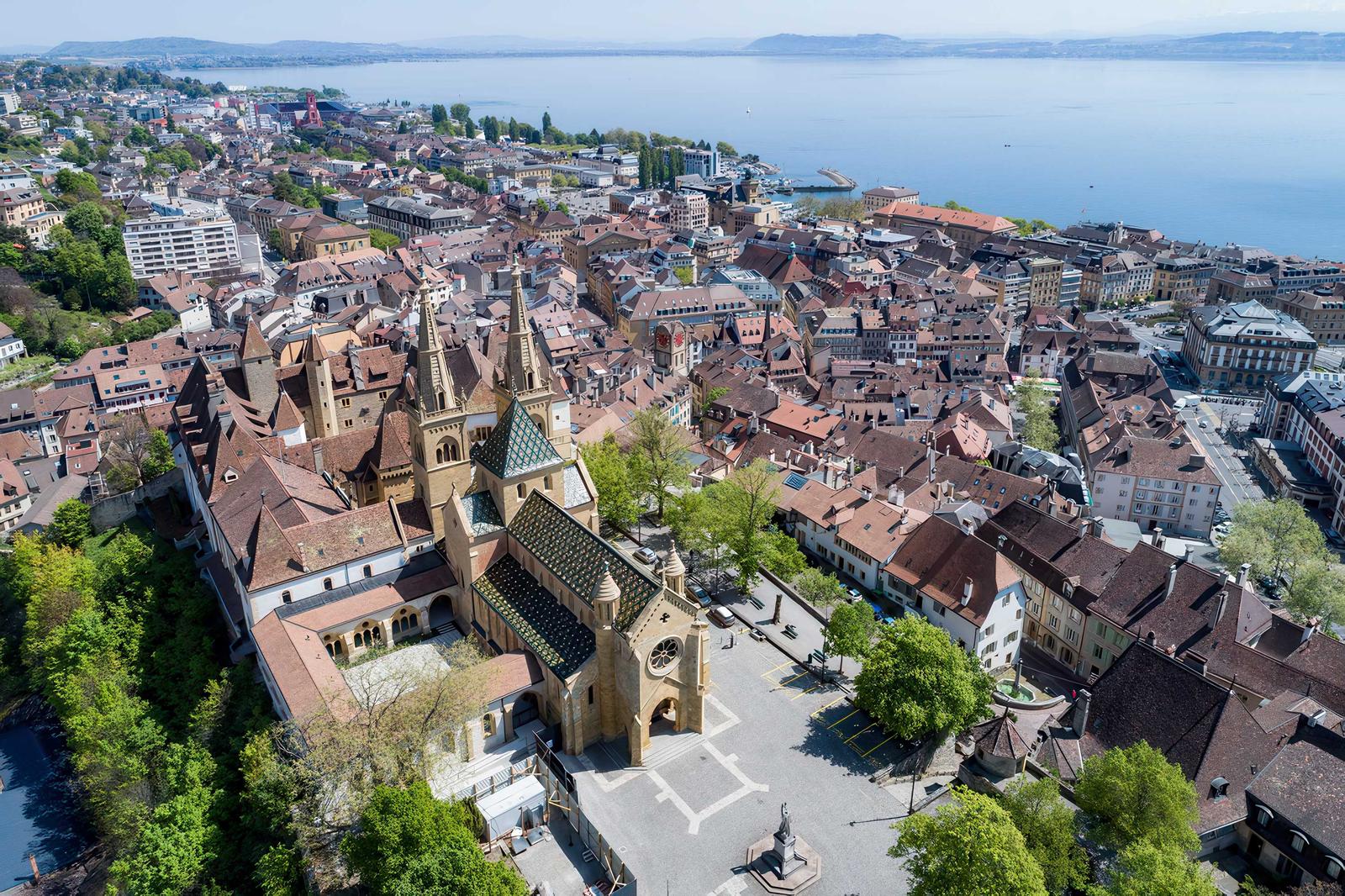
Neuchâtel sits where the Jura mountains slope down into the lake. From the train station, the town drops toward the harbour: first the yellow sandstone facades of the old town, then the water. The municipality counts around 45,000 residents, plus thousands of university students on any given weekday. For monuments, there is a castle, a collegiate church and two municipal museums, plus Switzerland's largest archaeology museum a few minutes away. To see how the town actually runs day to day, go to the Place des Halles market, swim at the Nid-du-Crô lido or take the Fun'ambule funicular up to the university. This article covers both sides.
Between the lake and the Jura
Neuchâtel sits on the north shore of Lake Neuchâtel. The municipality includes, besides the town itself, Serrières, Chaumont, Corcelles-Cormondrèche, Peseux and Valangin. Its 22.91 square kilometres hold 44,898 residents; more than half the area is forest, just over a third built up. The official language is French, and the town's first written mention dates to 1011. The old town runs along the lakeshore, while residential neighbourhoods and forest climb the Jura slope up to the ridge, where the Alps come into view on a clear day.
Getting there and getting around
From Bern, the train reaches Neuchâtel in about 34 minutes. From Zurich, the journey takes a little over ninety minutes since the 2025 timetable change, with a change at Renens. Within the town, three funiculars handle the slope between the lake and the upper town. The Fun'ambule has run underground between the station and the lakeside university district since 27 April 2001: its 330-metre route covers a 46-metre height difference in one to two minutes and can carry up to 3,000 passengers an hour. Its two cars are named Maxime and Léa, after children born to two construction workers during the tunnel's build. For more altitude, there is the Funiculaire de Chaumont: since 1910, over a route of just above two kilometres, it has linked the La Coudre district with the 1,087-metre summit of Chaumont, where a lookout tower faces the Three-Lakes region and the Alps.
Castle, collegiate church and the stairs in between
From the station, Rue du Château climbs up to the castle; to start from the lake instead, follow Quai Ostervald across the Passerelle de l'Utopie to Place Pury, then climb Rue du Seyon past the Fontaine du Banneret into the upper town. Its oldest section, a wing dating from the late 12th century, is still in use today: it houses the cantonal government, the inner courtyard is open to all, and guided tours run from June to September, Tuesday to Sunday, at 2pm, 3pm, 4pm and 5pm, for 5 francs. Right next door stands the collegiate church, whose construction began in the 12th century; its Gothic cloister is freely accessible and planted with flowers in summer. To skip the many steps up to the upper town, a small lift on Rue de l'Évole runs straight up to the Tour des Prisons, with views over the rooftops of the lower town and the lake.
Swimming, vineyards and a garden in the Ermitage valley
In summer, swimming is part of daily life. Opened in 1990, the Nid-du-Crô pools cover 33,000 square metres with a 50-metre Olympic pool, diving platforms up to 10 metres, and direct access to a pebble beach; access to the lakeshore itself is free; during the summer season, there is a 7.– CHF admission fee for the swimming area and lawns. Those after plants rather than water will find the Botanical Garden in the Ermitage valley: created in 1998, it spans eight hectares with an alpine garden and greenhouses, free to enter year-round. To see vineyards, no trip is needed: just southwest of town lie some of the canton's most important wine slopes, planted mainly with Chasselas and Pinot Noir.
Museums: far more than art
For its size, Neuchâtel has a remarkable number of museums. The Museum of Art and History (MahN), opened in 1885 in a Renaissance-style building by architect Léo Châtelain, spreads art and regional history across more than twenty rooms; its best-known pieces are three automata built by Pierre Jaquet-Droz between 1768 and 1774, demonstrated every first Sunday of the month. It's open Tuesday to Sunday, 11am to 6pm; admission costs 8 francs for adults, 4 for students and retirees, and entry is free on Wednesdays. The Museum of Ethnography (MEN), housed since 1904 in the Villa de Pury above the town, displays objects from around the world and sits right next to the castle. Outside the town centre, in nearby lakeside Hauterive, stands the Laténium: Switzerland's largest archaeology museum, opened in 2001, spreading 500 centuries of regional history across 2,200 square metres. Closed Mondays, it opens Tuesday to Sunday 10am to 5pm, costs 12 francs for adults and 4 reduced, and is free on the first Sunday of every month.
Xamax, Young Sprinters and a swim afterwards
Football and ice hockey are the town's two big club sports. The Young Sprinters Hockey Club plays its home games at the Patinoire du Littoral, and the football club Neuchâtel Xamax FCS is also based in town. For those wanting to join in themselves, the Nid-du-Crô pools offer, besides the pools, beach volleyball courts, table tennis and a diving platform up to 10 metres.
Market, Case à Chocs and student life
The market sets up on Place des Halles, and on Saturdays also on Rue du Seyon: three times a week in the warm season, twice in winter, with 30 to 50 stalls selling vegetables, cheese, lake fish, farm meat, flowers and pastries. Saturday morning is the busiest slot, when the surrounding restaurants and terraces fill up. Smaller neighbourhood markets run on Fridays in Valangin, on the large car park below the castle there, and in Peseux, on Place de la Fontaine. Nightlife largely runs through Case à Chocs: founded in 1991 as a rehearsal space by the Association des musiciens neuchâtelois, it moved in 1996 into the former Müller brewery on Quai Philippe Godet, where it now runs concerts, DJ nights and screenings across three halls holding 80 to 820 people. The University of Neuchâtel brings a young crowd to the neighbourhoods around the Fun'ambule and the lake.
When the grapes ripen in autumn
The year's highlight is the Fête des Vendanges, the grape harvest festival held on the last weekend of September, from Friday 6pm to Sunday midnight. A first procession took place in 1900, the festival has run regularly since 1902, and a dedicated association was founded in 1925 to organise it, which it still does today. The high point is the flower-float parade on Sunday afternoon, which draws more than 100,000 spectators along the route; across the full three days, the festival attracts up to 340,000 visitors. The wines poured are from the region, chiefly the local Chasselas, known here as Neuchâtel blanc, and the Œil-de-Perdrix rosé. Outside festival days, the grape harvest itself, in the vineyards southwest of town, remains a quieter affair.
Frequently asked questions
How long is the train ride from Bern to Neuchâtel?
The train takes about 34 minutes. Source: Bern–Neuchâtel connection.
Are Neuchâtel's museums free on a particular day?
The Museum of Art and History is free on Wednesdays, and the Laténium is free on the first Sunday of each month.
Where can you swim in the lake in Neuchâtel?
The most popular spot is the Nid-du-Crô pools, with their pebble beach and direct lake access.
When is the market in Neuchâtel?
The market sets up on Place des Halles, and on Saturdays also on Rue du Seyon: three times a week in the warm season, twice in winter.
When is the Fête des Vendanges in Neuchâtel?
It runs on the last weekend of September, from Friday evening to Sunday midnight, with the big flower-float parade on Sunday afternoon.
How do you get from the station down to the lake?
The fastest way is the underground Fun'ambule, which connects the station to the university district in one to two minutes.
How much does entry to Neuchâtel Castle cost?
The guided tour costs 5 francs and runs June to September, Tuesday to Sunday; the inner courtyard is free to enter year-round.